Headlight Restoration in Phoenix & Scottsdale: What It Fixes and How Long It Lasts
By Anthony Verrelli, 18+ years in detailing and paint protection
Quick answer
Headlight restoration removes the yellowed, failed UV coating and oxidation from the outside of a polycarbonate lens. The lens is wet-sanded in stages, polished back to clarity, then sealed with new UV protection. It doesn't fix moisture or haze inside the housing, cracks or failed seals. Those need repair or replacement.
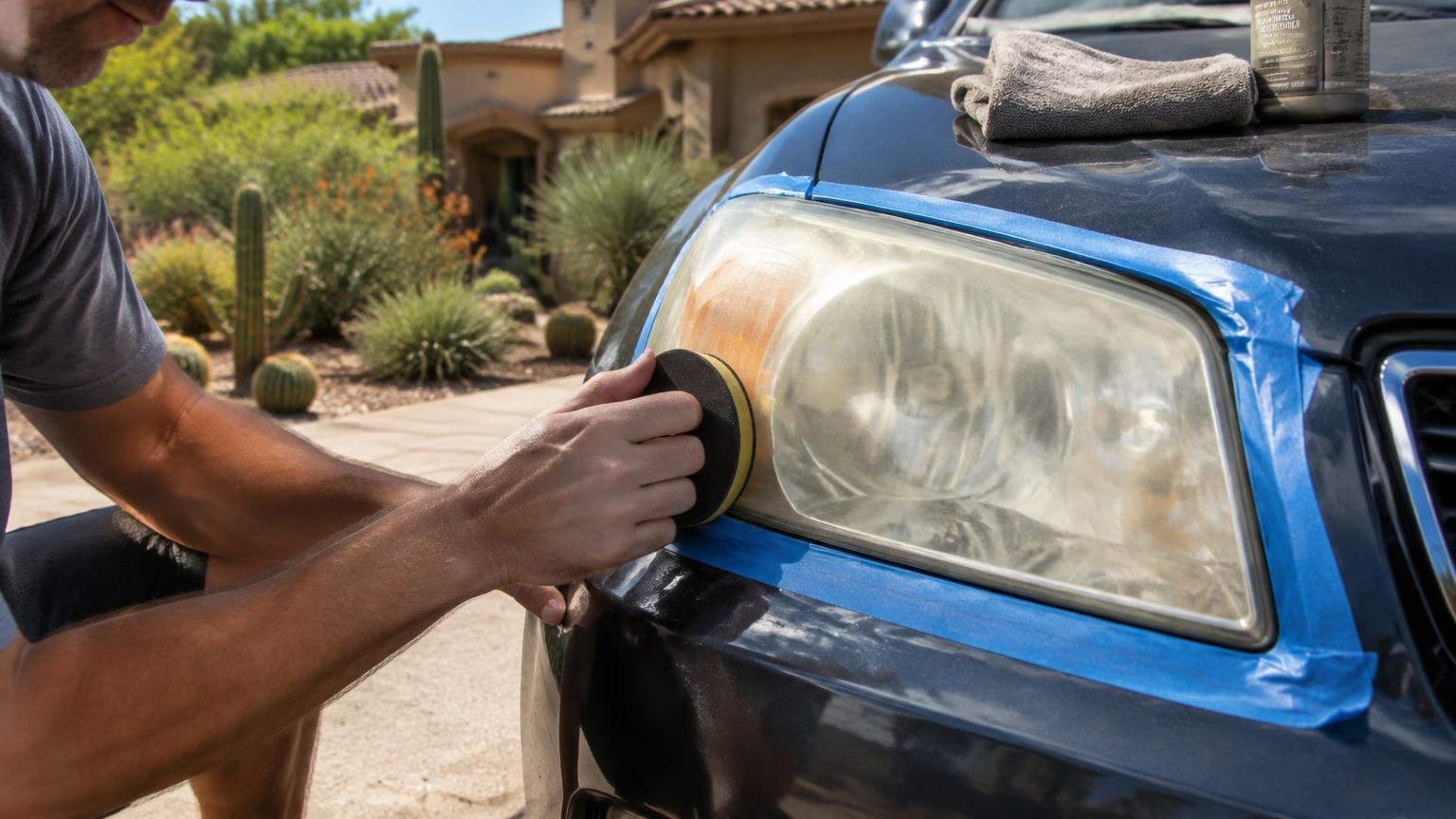
Why do headlights go yellow in Arizona?
Almost every modern headlight lens is polycarbonate. It's tough and light, but on its own it doesn't handle UV well. So the factory adds a thin, clear UV hard coat on the outside.
That coat is what the sun attacks. Over time it breaks down, goes chalky and starts to yellow. Once it's failed, the plastic underneath is exposed and oxidizes too. Arizona speeds all of it up: strong UV most of the year, extreme heat, blowing dust, and automatic car wash brushes and harsh chemicals that wear the surface further. The full explanation is in why headlights go yellow and cloudy.
How does professional headlight restoration work, step by step?
1. Assessment
First, we check whether the damage is outside or inside the lens, and look for cracks, chips and moisture. If the problem is inside the housing, restoration won't help, and we'll say so.
2. Masking
The paint, trim and bumper around the lens are taped off. Sanding next to paint without masking is one of the most common ways DIY jobs go wrong.
3. Staged wet sanding
The failed coating has to come off completely. Leaving patches of it behind is why some restorations look blotchy. We wet-sand in stages, starting coarse enough to remove the old coat and the oxidation, then working through finer grits so each stage removes the marks of the one before.
4. Polishing to clarity
Sanding leaves the lens evenly frosted. Machine polishing then brings it back to clear. This is where an even, careful sanding job pays off. Skipped grits show up here as fine scratches you can see when the lights are on.
5. New UV protection
This is the step that matters most, and the one most often skipped. Sanding removed the factory UV coat. If nothing replaces it, bare polycarbonate is sitting in the Arizona sun with no protection at all, and it will haze again quickly. A proper UV-protective coating goes on, and for cars that will be kept, we often recommend headlight PPF or ceramic coating on top.
How long does headlight restoration last?
There's no honest single number, and you should be wary of anyone who gives you one. How long the result holds up depends on a few things you can control:
- The protection step. A restoration finished with real UV protection lasts far longer than a sand-and-polish job left bare. This is the biggest factor.
- Where the car is parked. A garage-kept car is out of the sun most of the day. A car parked on the street or in an open lot is taking UV for hours, every day.
- How it's washed. Automatic wash brushes and harsh chemicals wear down protective coatings. Gentle hand washing keeps them working longer.
- Added protection. PPF or a coating over the restored lens adds another layer between the sun and the plastic.
Headlight self-check: can my headlights be restored?
- Clean the lens first. Wash it and dry it. Dust and road film make a lens look worse than it is.
- Find where the haze is. Look at the lens at an angle in daylight. If the haze looks like it's on the surface, it's usually the outside. If you can see fog, droplets or a film on the inside wall, it's inside the housing.
- Feel it. Run a clean fingertip across the lens. A rough, chalky or sandpaper feel means the outer hard coat has failed. That's what restoration fixes.
- Check the top. Yellow patches heaviest on the top or sun-facing side point to UV damage on the outside of the lens.
- Look for moisture. Water droplets or condensation inside the lens, especially after a wash or a cool morning, mean a seal has failed. Polishing the outside won't fix that.
- Look for cracks and chips. Cracks through the lens or broken mounting tabs need repair or replacement, not restoration.
When isn't headlight restoration the answer?
To be straight about limits: restoration only fixes the outside of the lens. Haze or moisture inside the housing, cracks, and failed seals mean the housing needs repair or replacement. A good detailer will tell you that before starting, not after.
- Moisture or condensation inside the lens. A seal has failed. The housing needs resealing or replacing.
- Haze or yellowing on the inside surface. You can't reach it to sand or polish without opening the housing.
- Cracks through the lens or broken mounting tabs.
- Burnt or discoloured reflectors inside the housing, which dim the light no matter how clear the lens is.
Do cloudy headlights affect night visibility?
Yes. A yellowed, hazy lens scatters and blocks light, so less of it reaches the road where you need it. Light can also spread in the wrong directions, which can add glare for oncoming drivers. If your lights look dim at night, restoration is a safety fix as much as a cosmetic one.
Here's how each option compares
| Option | Cost tier | What it fixes | Clarity | Holds up | Best for |
|---|---|---|---|---|---|
| Do nothing | Low | Nothing; haze keeps building | Keeps getting worse | Damage continues in the sun | Nobody, if you drive at night |
| DIY kit / household hacks | Low | Light outer haze, if done carefully; hacks only clear it briefly | Varies with skill | Often hazes again quickly without real UV protection | Light haze on an older daily car |
| Professional restoration | Medium | Removes failed coating and outer oxidation, then adds new UV protection | Strong, even clarity | Depends on the protection step, parking and washing | Most yellowed or cloudy lenses |
| Restoration + PPF or coating | Medium | Same as restoration, plus a protective layer over the lens | Strong, even clarity | Best chance of a lasting result | Cars you plan to keep; sun-parked cars |
| Replacement headlight assembly | High | Everything, including inside-the-lens haze, cracks and failed seals | As new | New lens still needs protecting in Arizona | Internal moisture, cracks, broken housings |
Can headlight restoration be done in my driveway?
Yes. It needs water, power, shade and time, all of which we bring or set up on site. We work in your driveway or at your office in Scottsdale, Paradise Valley, North Phoenix and Cave Creek. No drop-off, no ride to arrange. We work in the shade or early in the day, because hot lenses and hot panels make sanding and coatings harder to control.
If my headlights are yellow, is my paint damaged too?
Often, yes. The same sun that broke down the headlight's hard coat has been working on the clear coat, the black trim and the dashboard for just as long. Headlights simply show it first, because polycarbonate yellows where paint tends to fade, dull and haze more quietly.
So while the lenses are being done, it's worth looking at the hood and roof in direct sun. Dull patches, light swirls and faded trim are common on cars that have yellow headlights. That's where paint correction and ceramic coating come in. More detail in how the Phoenix sun damages car paint.
Just bought a pre-owned car with tired headlights? That's usually a sign the whole car needs a reset. See how to make a used car feel new in Arizona. And if there are light marks around the lenses from a previous DIY attempt, see scratch removal.
Frequently asked questions
What does headlight restoration fix?
It removes yellowing, haze and oxidation from the outside of the lens and replaces the failed UV coating. It does not fix moisture or haze inside the housing, cracks or failed seals.
How long does headlight restoration last?
It depends mainly on whether new UV protection is applied, where the car is parked, and how it's washed. Restorations left without UV protection tend to haze again quickly.
Can you restore headlights with moisture inside?
No. Moisture inside the lens means a seal has failed. The housing needs resealing or replacing; polishing the outside won't fix it.
Is headlight restoration worth it?
Usually, if the damage is on the outside of the lens. It restores clarity and night visibility for far less than a replacement assembly.
Do you offer mobile headlight restoration?
Yes. We'll restore headlights in your driveway or at your office in Scottsdale, Paradise Valley, North Phoenix and Cave Creek.
Should I protect my headlights after restoring them?
Yes. Sanding removes the factory UV coat, so new UV protection is essential. PPF or ceramic coating on top gives the result the best chance of lasting.