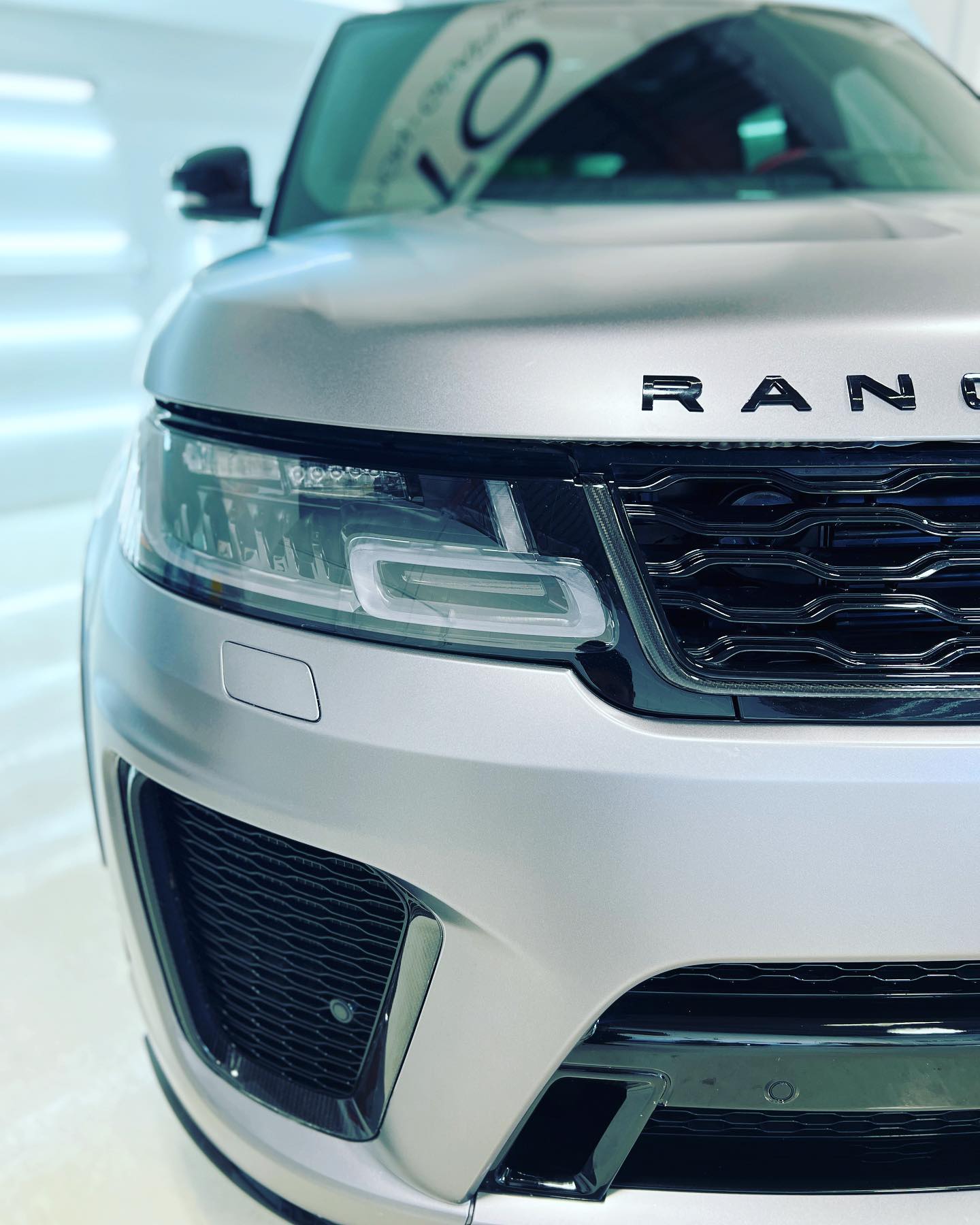
Land Rover Defender: New-Vehicle Ceramic Coating
A near-new Defender protected before its first real-world exposure, with dealer-installed transport marring corrected and a graphene ceramic system applied for long-term protection.
The vehicle and its condition
This Defender was only a few weeks old, but paint depth readings still averaged 122–134 microns across the body panels — normal factory thickness, but a reminder that even brand-new paint needs to be handled carefully. Under inspection, the paint showed light dealership wash marring (fine linear swirls consistent with an automated tunnel wash), a scattering of transport-film compression marks on the hood from the plastic wrap used during shipping, and a few small rail-dust specks embedded in the clear coat on the roof and bonnet. There was no oxidation and no deep scratching — this was purely a "protect it before it gets worse" job rather than a defect-heavy correction.
The process
Even on a near-new vehicle, decontamination came first: a foam pre-wash to loosen surface grit, a full two-bucket hand wash, and a fine clay bar pass specifically to lift the embedded rail dust that a wash alone wouldn't remove. All rubber trim, badges and the roof rack mounting points were taped off before any machine work.
Because the marring was light and the paint was factory-fresh, a single-stage machine polish was chosen instead of a full multi-stage correction — enough to remove the wash swirls and transport marks without unnecessarily thinning healthy factory clear coat. A test spot was still run on the tailgate first to confirm the pad and polish combination cleared the marring in one pass before it was carried across the rest of the vehicle.
Once every panel was polished and wiped down with an IPA panel prep to remove polishing oils, the ceramic coating was applied in two coats to the paint, wheels and glass, with a separate fabric-safe coating applied to the exterior plastic cladding and rock sliders — a step that matters on a body-clad SUV like the Defender where UV fading of black trim is a common long-term issue.
Products and steps
- Decontamination: pH-neutral foam pre-wash, two-bucket hand wash, fine-grade clay bar
- Single-stage polish: Rupes BigFoot Mille with a medium foam pad and Rupes Zephir compound-polish
- Panel prep: IPA wipe-down before coating
- Paint/wheels/glass protection: two coats of IGL Kenzo Graphene ceramic coating
- Exterior plastic cladding & rock sliders: dedicated trim coating (Gtechniq TrimRestore-style) to prevent UV graying
- Final inspection under LED swirl-finder lighting before handover
The result
The dealer wash marring and transport marks were fully removed, leaving the factory paint looking as close to showroom-fresh as possible. The two-coat ceramic system now gives the Defender several years of hydrophobic, UV and chemical protection, with the added benefit of the dedicated trim coating keeping the black cladding from fading and graying the way unprotected plastic trim typically does within the first year or two of ownership.
Roughly what work like this costs
Single-stage polish plus a multi-year ceramic coating package on an SUV like the Defender typically runs $1,200–$2,200, depending on paint condition, panel count and coating tier.
Pricing is indicative only and varies with vehicle condition, size and the scope of correction required. Every quote follows an in-person or photo-based paint assessment.
Want results like this on your car?
18+ years, 3,000+ vehicles, including exotic paint correction. Monthly care through the Caretaker membership. A caretaker calls you to set it up.