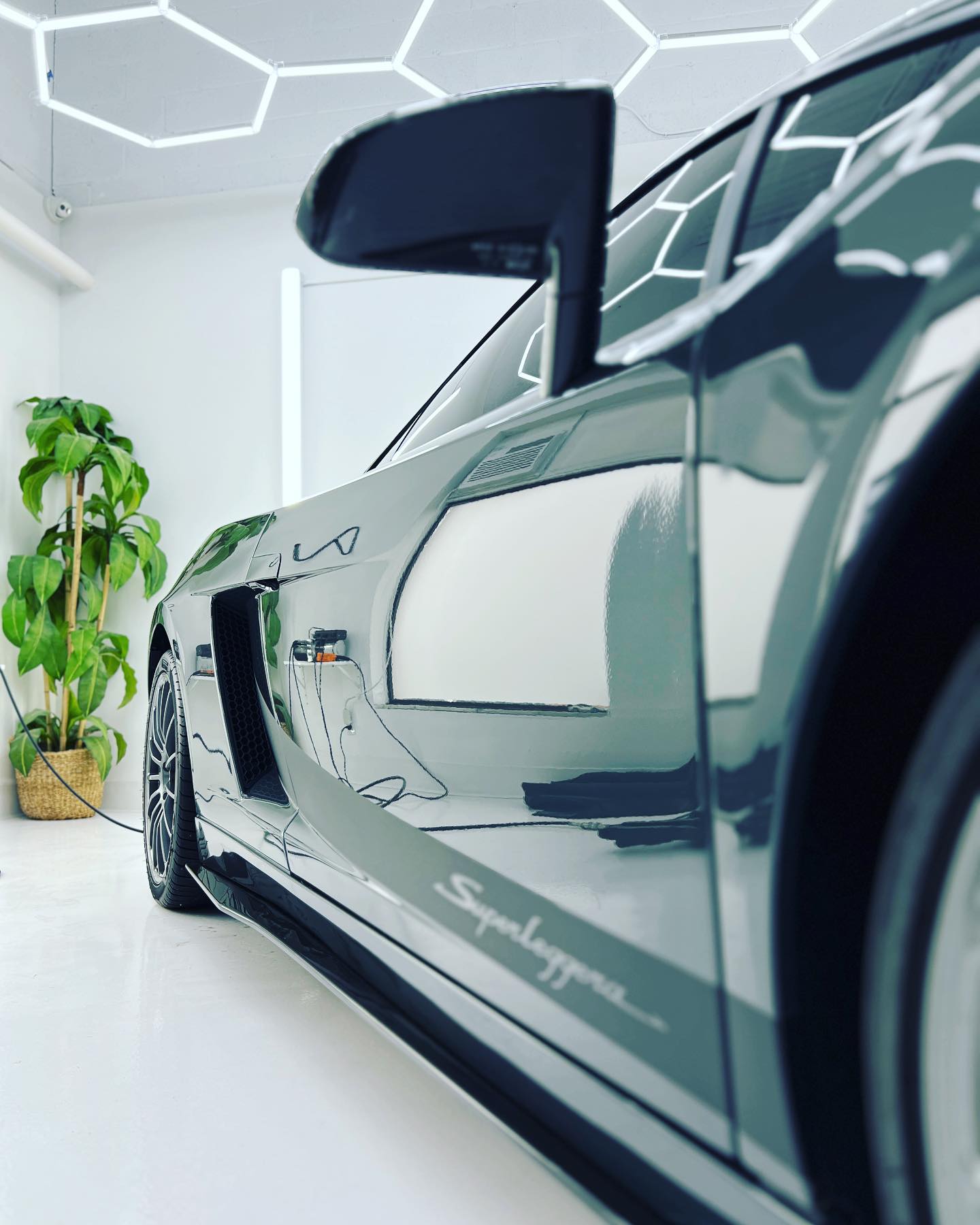
Aston Martin Superleggera: Full Correction & Protection
A dull, heavily swirled Superleggera brought back to a deep, reflective finish through a full two-stage correction and sealed under a 5-year ceramic system.
The vehicle and its condition
Paint thickness readings on this Superleggera averaged 128–140 microns on the aluminum body panels, with the composite front fenders reading slightly different due to the substrate change — a detail that mattered when choosing correction depth. Inspection under high-CRI LED lighting revealed dense fine swirling across every horizontal surface consistent with years of automated car washes, along with moderate oxidation haze in the clear coat on the hood and roof from UV exposure and infrequent paint protection. There were also several 2–4 inch scuffs on the front splitter and rocker panels from low ground clearance, plus light water-spot etching across the roof from mineral-heavy rinse water left to air-dry.
The process
The vehicle was decontaminated first: a foam pre-soak to lift loose grit, a two-bucket wash with grit guards, an iron-remover treatment to pull embedded brake dust and rail contamination out of the clear coat, and a fine-grade clay bar pass to remove bonded overspray near the rockers. Sensitive trim — badges, splitter edges, exhaust tips — was fully taped off before machine work began.
Because paint readings varied slightly between the aluminum panels and the composite fenders, two separate test spots were run to confirm safe correction depth on each substrate. The oxidation haze on the hood and roof needed a stronger initial cutting pass, while the door panels — mostly fine swirling — needed only a single medium-cut stage followed by finishing polish. The splitter scuffs were treated as isolated defect repairs, worked individually with a smaller pad before blending into the surrounding panel.
After correction, all panels were wiped down with a solvent panel prep to strip any polishing oils before the coating system was applied in two thin, even coats with flash time between each, then left to cure under controlled airflow away from dust and direct sun.
Products and steps
- Decontamination: Koch-Chemie Iron X, pH-neutral foam pre-soak, fine-grade clay bar
- Cutting stage (hood/roof oxidation): Rupes BigFoot LHR15 with a Rupes coarse foam pad and Meguiar's M105 compound
- Medium correction (doors/quarters): Rupes medium foam pad with Menzerna Power Gloss
- Isolated scuff repair (splitter/rockers): Flex PE14 rotary with wool pad, hand-blended edges
- Finishing polish: Menzerna Final Finish for full panel clarity and jeweled gloss
- Panel prep: IPA wipe-down before coating application
- Protection: two-layer application of IGL Kenzo Graphene ceramic coating (5-year system)
The result
Swirl-finder inspection after correction showed close to full removal of the fine surface marring and oxidation haze, with the splitter and rocker scuffs no longer visible at arm's length. The Kenzo Graphene coating restored a deep, wet-look gloss across every panel and gives the owner years of hydrophobic, UV-resistant protection without needing to repeat the correction stage for the life of the coating.
Roughly what work like this costs
A full correction plus multi-year ceramic protection package on a car like the Superleggera typically runs $1,600–$2,800, depending on paint condition and coating tier selected.
Pricing is indicative only and varies with vehicle condition, size and the scope of correction required. Every quote follows an in-person or photo-based paint assessment.
Want results like this on your car?
18+ years, 3,000+ vehicles, including exotic paint correction. Monthly care through the Caretaker membership. A caretaker calls you to set it up.