Mobile Detailing for Car Dealerships in Scottsdale & Phoenix
By Anthony Verrelli, 18+ years in detailing and paint protection
Quick answer
A mobile partner can complete reconditioning details, delivery details and scheduled inventory care on the dealership lot. The right scope depends on the unit: recon corrects paint and deep-cleans the interior, a delivery detail prepares a sold vehicle for handover, and a lot wash maintains already-reconditioned inventory. Extra on-lot capacity also helps dealers absorb off-lease and auction-buy peaks without adding permanent staff.
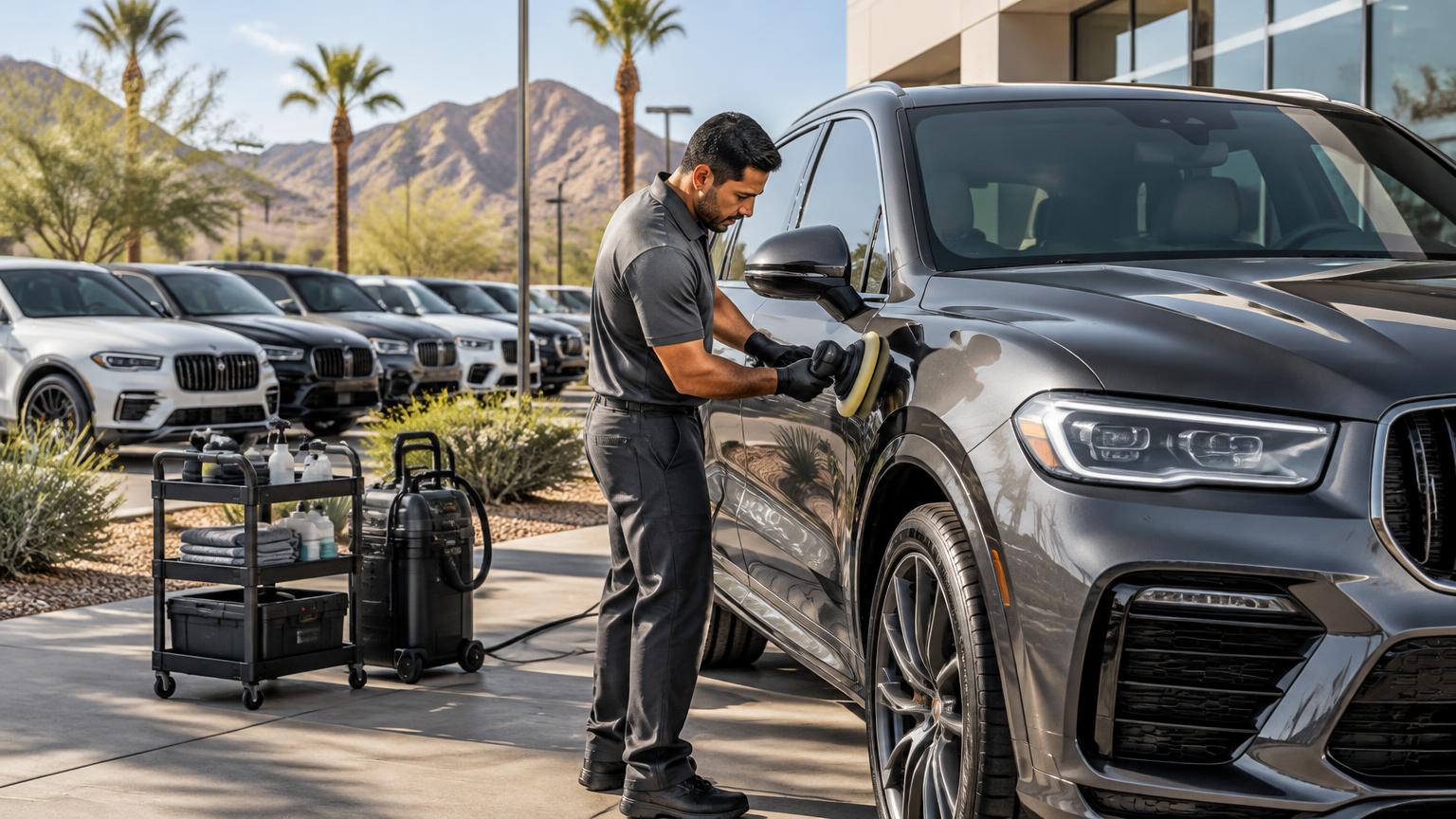
What are dealership detailing services?
Dealership detailing is not one job. A trade-in headed for the front line needs a different level of work from a sold vehicle waiting for delivery. Inventory that has already been reconditioned needs another standard again. Treating all three as the same wash creates wasted labour, inconsistent results and missed front-line dates.
For used car managers, recon managers and GMs, the useful question is not simply whether a vehicle is clean. It is whether the unit is ready for its next stage: photography, front-line display, test drive or customer handover. A mobile recon partner works against that stage while keeping the vehicle on your property.
Recon detail vs. delivery detail vs. lot wash
Recon detail
A recon detail resets a newly acquired unit. It starts with an intake inspection, paint readings and a defect map. The work may include decontamination, one-step paint correction, targeted scratch and scuff work, headlight restoration, interior steam and extraction, pet-hair removal and odour treatment. The goal is a consistent front-line standard, not a temporary shine.
Use recon for trade-ins, auction purchases, off-lease vehicles and any retail unit whose condition will show in photographs or during a walk-around. For the off-lease-specific workflow, see dealership lease-return reconditioning in Phoenix.
Delivery detail
A delivery detail is the final preparation of a sold unit. The major correction work should already be complete. This stage removes lot dust and fingerprints, cleans glass, refines the interior, checks jambs and touchpoints, dresses tyres without sling and presents the keys and cabin properly. It should be controlled and careful; aggressive polishing on delivery day means something was missed earlier.
Lot wash
A lot wash maintains inventory that is already retail-ready. It removes dust, pollen and light contamination without reopening the entire recon process. It should use a paint-safe method, because repeated dry wiping or rushed washing can put swirls back into corrected paint. A lot wash is maintenance, not reconditioning.
Keeping these definitions separate makes scheduling clearer. Recon gets a stock number ready for sale. Delivery prepares a sold car for its new owner. Lot washing protects the work already completed.
How can a mobile recon partner handle volume peaks?
Dealer volume rarely arrives evenly. Off-lease returns can land in waves. An auction buy may add a row of vehicles at once. A promotion can pull existing staff toward deliveries just as the used-car queue grows. Building permanent headcount around the busiest week leaves excess capacity during quieter periods, while understaffing the peak delays photos and front-line placement.
A mobile partner adds scheduled capacity on the lot. The store can keep its core staff focused on the normal flow, then add recon days when the queue passes an agreed threshold. Units stay at the dealership. Porters do not shuttle them across town, and managers retain visibility over the queue.
- Off-lease surges: reserve additional days when maturity volume is expected.
- Auction purchases: triage the batch at intake, then assign the right recon level per unit.
- Trade-in clusters: prioritize units by front-line date and retail value instead of arrival order alone.
- Delivery pressure: move sold-car preparation to a defined delivery lane so it does not interrupt deep recon.
- Staff absence: cover specialist detailing capacity without lowering the store's standard.
Flexibility only works with a clear handoff. The recon manager should own approval and priority. The mobile partner should report what was completed, what could not be corrected safely and which specialist vendor is needed next.
Recon intake checklist: what should be recorded?
- Identify the unit: stock number, VIN, mileage, acquisition source and target front-line date.
- Assign the next stage: wholesale, recon, photography, front line, sold or delivery.
- Record paint condition: paint depth by panel, repaint indicators, swirls, scratches, chips, scuffs, water spots and etching.
- Check exterior exceptions: dents, curb rash, cracked glass, tyre condition and bodywork that require another vendor.
- Check lights and trim: haze, yellowing, internal moisture, fading and damaged pieces.
- Inspect the cabin: stains, pet hair, smoke or pet odour, tears, burns, headliner condition and missing trim.
- Confirm missing items: keys, manuals, mats, cargo cover, charging cable and dealer-installed accessories.
- Choose the work level: lot wash, delivery detail, standard recon or enhanced recon.
- Document approval: note requested spot work, exceptions and the manager who approved the scope.
- Close the job: record completion, before-and-after photos, unresolved items and the next destination for the unit.
What do Arizona lot conditions do to stored inventory?
Sun
Arizona UV and panel heat work on inventory every day. Dark paint shows wash marks quickly. Black trim dries and fades. Headlight hard coats weaken and yellow. Vehicles parked nose-out can age unevenly across the hood, roof and exposed side. Correcting the vehicle once and then maintaining it safely protects the result better than repeated quick polishing.
Dust
Desert and monsoon dust are abrasive. A dry towel dragged across a dusty hood can mark the clear coat before the unit reaches a customer. Dust also settles into vents, jambs, seat rails and piano-black interior trim. Inventory care needs a safe removal method, not a fast dry wipe before every test drive.
Hard water
Sprinklers and rushed washing leave mineral deposits on paint and glass. Under Scottsdale and Phoenix heat, those spots can etch rather than wash off. Stored inventory is especially vulnerable because a wet vehicle may sit in direct sun. The practical response is shade where possible, controlled washing, complete drying and early removal. See the guide to hard-water spots on car paint in Phoenix.
How do dealership detailing options compare?
| Option | Cost tier | Capacity | Control | Best for |
|---|---|---|---|---|
| In-house recon | Medium | Fixed by staffing and bays | Direct control; quality depends on training and workload | Stable volume with an established recon team |
| Wholesale as-is | Low | Immediate exit from the recon queue | No cosmetic improvement before sale | Units that do not justify retail reconditioning |
| Mobile recon partner | Medium | Flexible days added on the lot | Agreed checklist, reporting and approval process | Peaks, specialist correction and pre-owned inventory |
| Body shop | High | Scheduled around repair workload | Formal repair order and refinishing process | Collision damage, deep paint damage, dents and repaints |
What should a dealer look for in a recon partner?
A consistent written standard
Terms like 'full detail' are too vague for a dealership queue. The partner should define each level, the expected result and what sits outside scope. Managers should be able to look at two completed units and see the same standard, even when their starting condition was different.
Insurance appropriate for on-lot work
Ask for proof of insurance before vehicles are assigned. Confirm that the policy fits mobile work around customer and dealer inventory. A professional partner should be comfortable supplying documentation and following the store's access, key-control and safety rules.
An on-lot workflow that does not disrupt sales
The setup area, water and power access, key handoff, vehicle movement and completed-unit location should be agreed before the first day. Tools and chemicals need to stay contained. Sales staff should always know which vehicles are unavailable and when they will return.
Clear reporting
Each unit should close with a record of completed work and unresolved exceptions. Before-and-after photos should use similar light and angles. Deep scratches, thin paint, repaint indicators, dents, wheels, tyres and glass should be reported rather than hidden. Clear reporting lets the manager decide whether to retail, repair or wholesale.
How should a dealership trial a mobile recon partner?
Start with a mixed group, not only the easiest cars. Include a light-wear unit, a typical trade-in and one vehicle with meaningful interior or paint work. Agree the standard, target completion time and reporting format before work starts. Review the results together after the first batch.
A useful trial answers four questions: Did the finished units meet the agreed standard? Did the workflow fit the lot? Was reporting clear? Did the added capacity move vehicles forward without creating more management work? If the answer is yes, set recurring days and a simple method for adding surge capacity.
For individual drivers preparing a vehicle for turn-in, see lease return detailing in Scottsdale. Dealership partnership inquiries can go through the contact form or directly to info@av-otto.com. Include your store, typical monthly units, current recon process and the standard you want.
Frequently asked questions
What is included in dealership detailing services?
The scope can include recon inspection, paint decontamination and correction, scratch and scuff work, headlight restoration, interior steam and extraction, odour treatment, delivery preparation and maintenance lot washing.
Can mobile detailing for dealerships be completed on the lot?
Yes. Work is completed in an agreed on-lot area, with a defined process for keys, vehicle movement, approvals and completed-unit reporting.
What is the difference between a recon detail and a delivery detail?
Recon corrects and resets a newly acquired vehicle for retail. A delivery detail is the final, lighter preparation of an already-reconditioned sold vehicle before handover.
Can a mobile recon partner help during off-lease or auction surges?
Yes. Additional scheduled days can add capacity during volume peaks without the dealership carrying that staffing level year-round.
How should dealerships protect inventory from Arizona dust and hard water?
Use paint-safe washing, avoid dry wiping, dry vehicles completely, remove mineral deposits early and keep corrected inventory on a defined maintenance schedule.
How does a dealership start a recon trial with AVOTTO?
Email info@av-otto.com or use the contact form with your store, monthly unit volume, current bottleneck and desired recon standard. The first step is a small mixed batch on your lot.